There are animals that survive Africa. Then there are animals that argue with Africa and win.
Enter the honey badger, also known as the ratel (Rah-til). A creature so stubbornly confident that lions reconsider their life choices, snakes regret their decisions, and beehives file restraining orders. This is not a blog about caution, elegance, or restraint. This is a celebration of chaos with claws.

Small body. Industrial-strength attitude.
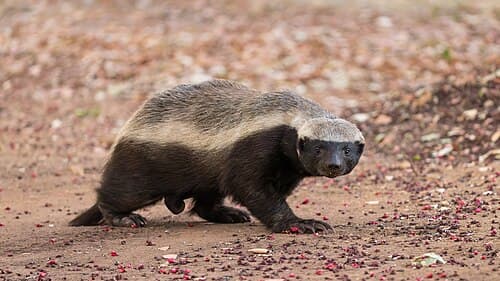
The honey badger (Mellivora capensis) looks like it was designed by someone who said, “What if we gave a tank feelings?”. Stocky, low-slung, and wrapped in famously loose skin, this animal is built for one purpose. Survive everything. Preferably while being rude about it.
That loose skin is not accidental. It allows honey badgers to twist, turn, and bite attackers even when grabbed. Think of it as nature’s get-out-of-jail-free jacket.
Honey badgers have one of the widest distributions of any African carnivore.
They are found across:
Southern Africa
East Africa
Parts of North Africa
The Middle East
India
They adapt to deserts, savannahs, forests, and semi-arid regions with equal enthusiasm. If there is food, the honey badger will arrive. If there is danger, the honey badger will arrive faster.
Seeing one on safari is never guaranteed. They are elusive, mostly nocturnal, and allergic to schedules. Which, frankly, makes the sighting even sweeter.
Honey badgers eat everything. Not figuratively. Literally.
Their menu includes:
Snakes, including venomous species
Scorpions
Rodents
Birds and eggs
Insects
Roots and bulbs
Carrion
Honey and bee larvae
They are famous for raiding beehives with zero concern for stings. Their thick skin and high pain tolerance mean bees are treated as background noise.
There is also documented behaviour of honey badgers surviving snake bites that would end most mammals. They may collapse, nap it off, and continue hunting later. Because of course they do.
Honey badgers are not known for sentimentality.
Females usually give birth to one or two cubs
Cubs stay with their mother for up to a year
Learning includes hunting, digging, and fearlessness training
Watching a honey badger mother is a masterclass in tough love. Cubs are encouraged to investigate everything, including things that could theoretically kill them. This is how legends are raised.
Why Nothing Messes With Them
Honey badgers have been observed:
Standing their ground against lions
Chasing leopards off kills
Attacking animals several times their size
Escaping traps with problem-solving skills that make humans uncomfortable
They do not bluff. They do not retreat. They escalate.
Scientists attribute this to a mix of intelligence, physical resilience, and an evolutionary strategy best described as “absolute refusal”.
Honey badgers can dig faster than most humans with tools
Their skull structure allows powerful bites relative to size
They have been filmed opening gates and containers
Some farmers call them “the animal equivalent of a bad idea that works”
Ask any seasoned guide and they will have a honey badger story.
One involves a honey badger trotting confidently down a road while a lion follows at a respectful distance, clearly unsure how things went wrong. Another includes a honey badger stealing food from a camp kitchen and leaving behind only confusion and bruised egos.
They do not sneak. They arrive
Honey badgers are most often spotted in:
Private reserves
Quiet safari areas with minimal vehicle pressure
Night drives and early morning game viewing
Their appearances are brief, unexpected, and unforgettable. Much like the animal itself.
Despite their reputation, honey badgers play an important ecological role. They control rodent populations, influence insect numbers, and contribute to balanced ecosystems across their range.
Protecting habitats protects not just the iconic species, but also the smaller, tougher characters holding the system together.
Many of the landscapes honey badgers rely on are under pressure from habitat loss and human expansion.
Through the Indigo Earth Foundation, Indigo Safaris supports conservation initiatives focused on habitat protection, education, and long-term sustainability across Africa.
Supporting conservation means protecting the entire cast, including the ones with attitude.
Seeing a honey badger in the wild is never guaranteed. But that is the point.
With Indigo Safaris, you travel deeper, slower, and smarter. You visit regions where nature sets the rules and unexpected encounters still happen.
If you are lucky, you might spot a low-slung shape crossing the track, radiating confidence, and reminding everyone who is really in charge.
文章评分